Thursday, 26 January 2012

Thursday, 19 January 2012
Shadow of a doubt
Shadow Of A Doubt directed by Alfred Hitchcock
In class we watched and analysed a clip of the film Shadow Of A Doubt. This is one of Alfred Hitchcock's many famous films.
- People dancing
- The characters are wearing old looking clothes which shows that the film is set in the early 1900s
- The film is in black and white re-enforces the fact that the film is quite old.
- The music is also most commonly associated with the 1900s.
- Hitchcock shows a street, then a building, then a window, and finally a man lying on the bed. With each shot we get closer to seeing the main character.
- When we see the main character we see money lying around on the floor, which shows he is wealthy but doesn't care too much for the money.
- He is well dressed and smoking a cigar, so he obviously lives a wealthy life, but he seems to be depressed and lifeless.
Brick

Camera - Extreme closeup shot of both characters in scene emphasizing and intensifying the atmosphere of whats happened.
Editing - Editing is very slow, mainly to set the scene of the current circumstances.
Sound - Sound/music is slow with a sad effect which is suddenly interrupted by school bell.
Mise-en-scene - Stream, dead body partly within the stream. Another character watching in the short distance demonstrates his saddness and anxiety over the situation, can't believe what has happened.
Memento
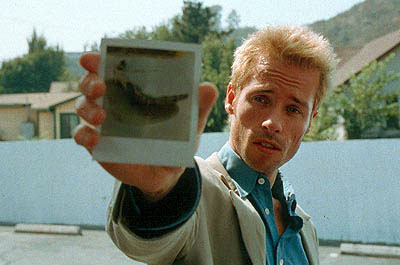
Conventions-Movie is told in an unusual backwards way. Everything is re-winded back, making it an unusual introduction.
Camera - Main close up shots of face used, black and white scene emphasizing flashbacks.
Editing - The editing is slow, getting fast from time to time. Slow editing is used to let the audience familiarize themselves to whats going on in the scene.
Sound - Saddening music is played in the background from the beginning, then eventually turning into creepy uneven music.
Mise-en-scene - Broken windows, old hotel, damaged and creepy furniture, the beginning starts at an abandoned old ranch/house. Intensifying props are weapons and the photographic camera used.
Thursday, 5 January 2012
Editing
Editing is term which is used to describe the process of looking at all the footage which has been shot during the making of a film placing it in the desired order and actually joining it together. When we are looking at editing in a film there are two areas to concentrate on:
Speed of editing-how long does each shot last?
When watching a piece of moving film of a certain length, it is visible that it has been joined together at certain appropriate points. Each scene may last a matter of seconds, or it could continue for minutes but the length of each sequence establishes the pace of the film moving action along. The speed of the editing will help determine the mood of what is happening within the scene- if the audience is to feel anxiety and suspense the editing will be quick (frequently changing scene). If a relaxed mood is desired, the scenes last longer ans change less frequently.
Style of editing-How each shot is joined to the next?
In the process of editing a film editor looks at the film footage that has been shot in production and joins shots together to make a continuous piece of film. The editor has various methods of doing this ans they will work in conjunction with the director to decide which to use.
Known methods are:
Straight Cut
Fade-out where the screen fades to black
Dissolve where one image is slowly brought in beneath another one
Wipe cut where one part of the screen moves to wipe across the other
Jump Cut where the audience's attention is brought into focus on something very suddenly
Speed of editing-how long does each shot last?
When watching a piece of moving film of a certain length, it is visible that it has been joined together at certain appropriate points. Each scene may last a matter of seconds, or it could continue for minutes but the length of each sequence establishes the pace of the film moving action along. The speed of the editing will help determine the mood of what is happening within the scene- if the audience is to feel anxiety and suspense the editing will be quick (frequently changing scene). If a relaxed mood is desired, the scenes last longer ans change less frequently.
Style of editing-How each shot is joined to the next?
In the process of editing a film editor looks at the film footage that has been shot in production and joins shots together to make a continuous piece of film. The editor has various methods of doing this ans they will work in conjunction with the director to decide which to use.
Known methods are:
Straight Cut
Fade-out where the screen fades to black
Dissolve where one image is slowly brought in beneath another one
Wipe cut where one part of the screen moves to wipe across the other
Jump Cut where the audience's attention is brought into focus on something very suddenly
Production Meeting 1
Task 1
Create a spider diagram (on paper or word) of potential Thriller ideas.
Task 2
Take one idea and develop it through a second spider diagram, considering locations, props, camera walk, cast etc.
Task 3
Write a 'proposal' outlining your idea for a Thriller opening and the locations, props, cast etc that I require.
Task 4
Story Board.
Create a spider diagram (on paper or word) of potential Thriller ideas.
Task 2
Take one idea and develop it through a second spider diagram, considering locations, props, camera walk, cast etc.
Task 3
Write a 'proposal' outlining your idea for a Thriller opening and the locations, props, cast etc that I require.
Task 4
Story Board.
Denotation
Denotation - A literal description of an object or concept or idea.


Connotation-What is associated with an object, concept or idea

![]()
Connotation-What is associated with an object, concept or idea


Subscribe to:
Posts (Atom)