
Thursday, 8 December 2011
Enigmas
This refers to a puzzle, something mysterious or inexplicable , or a riddle or difficult problem. In thrillers this is commonly something which the protagonist has to try to find out or solve before the narrative is resolved and the film finishes.


Hitchcocks ''Maguffin''
A MacGuffin ( sometimes McGuffin or Maguffin) is a plot device that motivates the characters and advances the story but has little other relevance to the story.
Quote '' We have a name in the studio,and we call it the ''MacGuffin'', It is the mechanical element that usually crops up in any story. In crook stories it is always the necklace and in spy stories it is always the papers.''
 |
| ''A plot element that catches the viewers' attention or drives the plot of a work fiction'' |
Quote '' We have a name in the studio,and we call it the ''MacGuffin'', It is the mechanical element that usually crops up in any story. In crook stories it is always the necklace and in spy stories it is always the papers.''
Thursday, 1 December 2011
Aspects of the Thriller Hitchcock
Alfred Hitchcock was the master of suspense whose films came to be the benchmark for 'Psychological' thrillers. Under the strong influence of Alfred Hitchcock, Thrillers often begin with a crime and the accusation of an innocent bystander, were the accused to contact the authorities, no doubt the cases could be promptly solved, but instead the poor bystander runs from the law thus further jeopardising life and limb.
Quotes
''There is no terror in the bang, only in the anticipation of it''
''If it's a good movie, the sound could go off and the audience would still have a perfectly clear idea of what was going on ''
''Always make sure the audience suffer as much as possible''
''I am a typed director. If i made Cinderella, the audience would immediately be looking for a body in the coach''
Wednesday, 30 November 2011
Thriller Films
THRILLERS
The 'Thriller' term is a very difficult genre to pin down because it covers such a wide ranger of films. Thrillers use suspense, tension, and excitement as the main elements to instill terror into the audience. Successful examples of thrillers are the films of Alfred Hitchcock.
Methods
Crime Thrillers : Ransoms, Captivities, Heists, Revenge, Kidnappings
Mystery Thrillers : Investigations and the ''who done it'' technique.
Psychological Thrillers : Mind games, Stalking, Confinements, Deathtraps, Horror of personality, Obsession.
Paranoid Thrillers : Fringe Theories, False accusations, Paranoia.
The 'Thriller' term is a very difficult genre to pin down because it covers such a wide ranger of films. Thrillers use suspense, tension, and excitement as the main elements to instill terror into the audience. Successful examples of thrillers are the films of Alfred Hitchcock.
Methods
Crime Thrillers : Ransoms, Captivities, Heists, Revenge, Kidnappings
Mystery Thrillers : Investigations and the ''who done it'' technique.
Psychological Thrillers : Mind games, Stalking, Confinements, Deathtraps, Horror of personality, Obsession.
Paranoid Thrillers : Fringe Theories, False accusations, Paranoia.
 |
| Thrillers tend to have a protagonists (right) who are usually unaware of the antagonists (left) true colours. |
Monday, 28 November 2011
Storyboard/Animation-Eagles Path
This is my storyboard animation for the title "Eagles Path". Its a short storyboard of an opening story. Its mainly about an approaching storm which threatens a small cottage and its owner. It turns nasty with the development of a tornado which rips the cottage in two, leaving nothing but its destructive path.
Thursday, 24 November 2011
Source Code
An action thriller centered on a soldier (Jake Gyllenhaal) who wakes up in the body of an unknown man and discovers he's part of a mission to find the bomber of a Chicago commuter train. This mind bending sci-fi thriller with packed action deals with some pretty heavy stuff including death, mourning and terrorism. The main character experiences the explosion of a passenger train over and over as he attempts to find out who's behind the bombing.
Sound Post
A sound film is a motion picture with synchronized sound, or sound technology which is corresponding to the image. The first known public exhibition of projected sound films took place in Paris in 1900. However, decades would pass before sound motion pictures were made commercially practicle.
In the early days of cinema when the extra dimension of sound was an acknowledged requirement, live music in the form of a piano, an organ or even a full orchestra would play in line with moving pictures which illustrated the recognized need of sound.
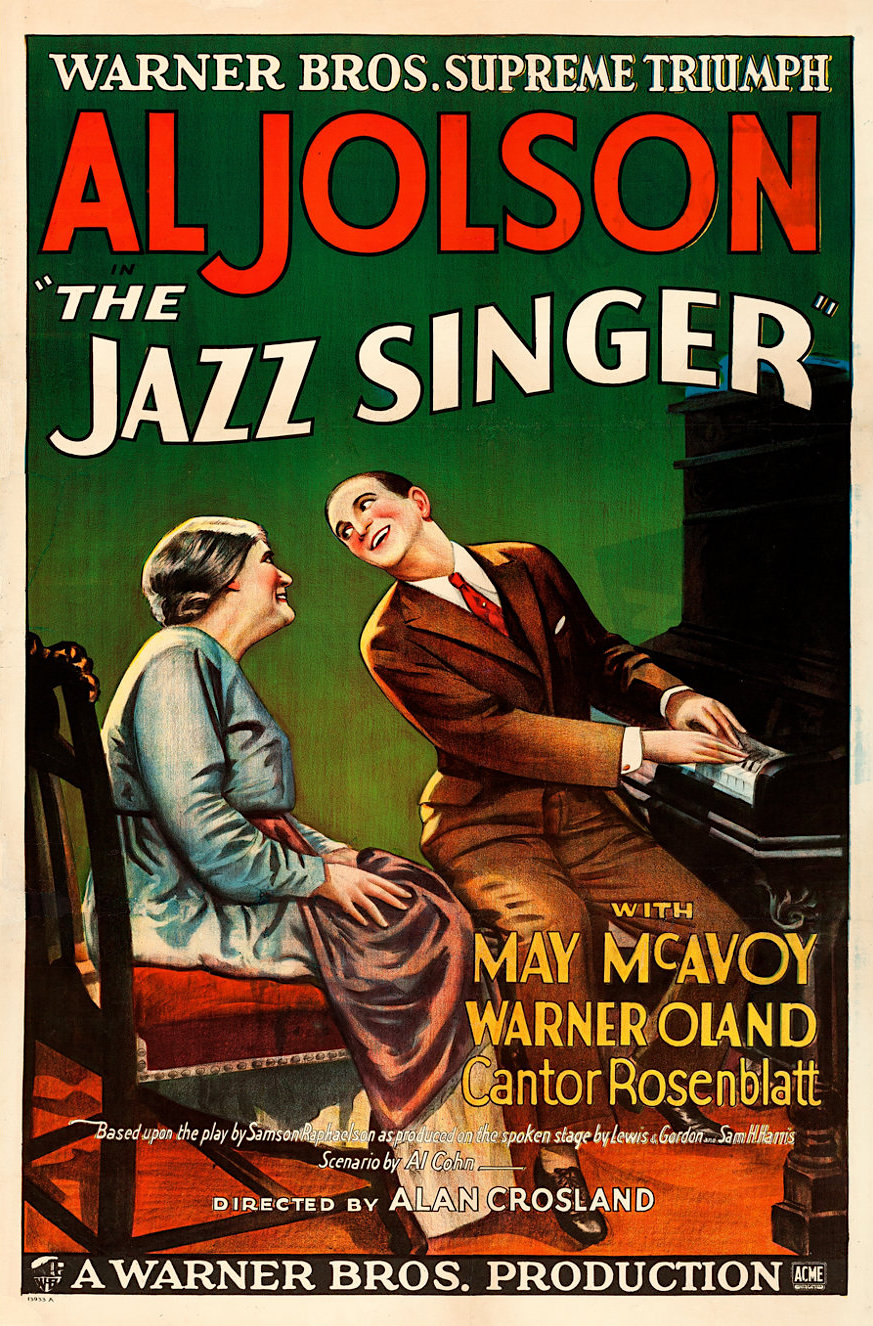
In 1927 Warner Brothers released the first feature film with a soundtrack-'The Jazz Singer' starring Al Jolson.
 However the implementation of sound technology was still delayed due to film companies unwillingness to invest large sums of money into sound equipment when they were making huge profits with silent movies. Nevertheless, the next commercial sound film 'Lights Of New York' released by Warner Brothers (a year after releasing 'The Jazz Singer') was so impressive that it stimulated a rapid and total conversion to sound within the entire film industry.
The film, which cost only $23,000 to produce, grossed over $1,000,000. It was also the first film to define the 'Crime' genre. The enthusiasm with which audiences greeted the talkies was so great that by the end of 1929, Hollywood was producing sound films exclusively.
DIEGETIC AND NONDIEGETIC SOUND
Diegetic sound is sound which is part of the film world we are watching. This can be dialogue, music or sound effects which come from a source within the films world. The music in this instance will be from a source in the film which we acknowledge could actually be producing music, for example a CD player or jukebox.
Non-Diegetic Sound is sounds which we as an audience do not recognize as part of the film world such as a voice-over or background music.
SOUND BRIDGES
When sound from one scene continues even though the visual has moved on to the next scene, is known as a sound bridge. This helps to create a smooth transition from one scene to another as the film would seem very disjointed if the sound changes every time the picture on the screen changed. This kind of actions is said to be enhancing the continuity of the film.
PARALLEL AND CONTRAPUNTAL SOUND
Usually when watching a film, the sound being herd normally complements the image that we see on the cinema screen. If we look at children playing on the beach, we'd expect to hear happy voices and light-hearted music-this is known as Parallel Sound. However, when we are watching these happy scenes in the beach but hear the sinister sounding theme signaling the arrival of a shark ;as seen in the film Jaws, this is known as Contrapuntal Sound because the sound we hear does not fit with the image we see on the cinema screen.
In the early days of cinema when the extra dimension of sound was an acknowledged requirement, live music in the form of a piano, an organ or even a full orchestra would play in line with moving pictures which illustrated the recognized need of sound.
In 1927 Warner Brothers released the first feature film with a soundtrack-'The Jazz Singer' starring Al Jolson.
The film, which cost only $23,000 to produce, grossed over $1,000,000. It was also the first film to define the 'Crime' genre. The enthusiasm with which audiences greeted the talkies was so great that by the end of 1929, Hollywood was producing sound films exclusively.

DIEGETIC AND NONDIEGETIC SOUND
Diegetic sound is sound which is part of the film world we are watching. This can be dialogue, music or sound effects which come from a source within the films world. The music in this instance will be from a source in the film which we acknowledge could actually be producing music, for example a CD player or jukebox.
Non-Diegetic Sound is sounds which we as an audience do not recognize as part of the film world such as a voice-over or background music.
SOUND BRIDGES
When sound from one scene continues even though the visual has moved on to the next scene, is known as a sound bridge. This helps to create a smooth transition from one scene to another as the film would seem very disjointed if the sound changes every time the picture on the screen changed. This kind of actions is said to be enhancing the continuity of the film.
PARALLEL AND CONTRAPUNTAL SOUND
Usually when watching a film, the sound being herd normally complements the image that we see on the cinema screen. If we look at children playing on the beach, we'd expect to hear happy voices and light-hearted music-this is known as Parallel Sound. However, when we are watching these happy scenes in the beach but hear the sinister sounding theme signaling the arrival of a shark ;as seen in the film Jaws, this is known as Contrapuntal Sound because the sound we hear does not fit with the image we see on the cinema screen.
Subscribe to:
Posts (Atom)